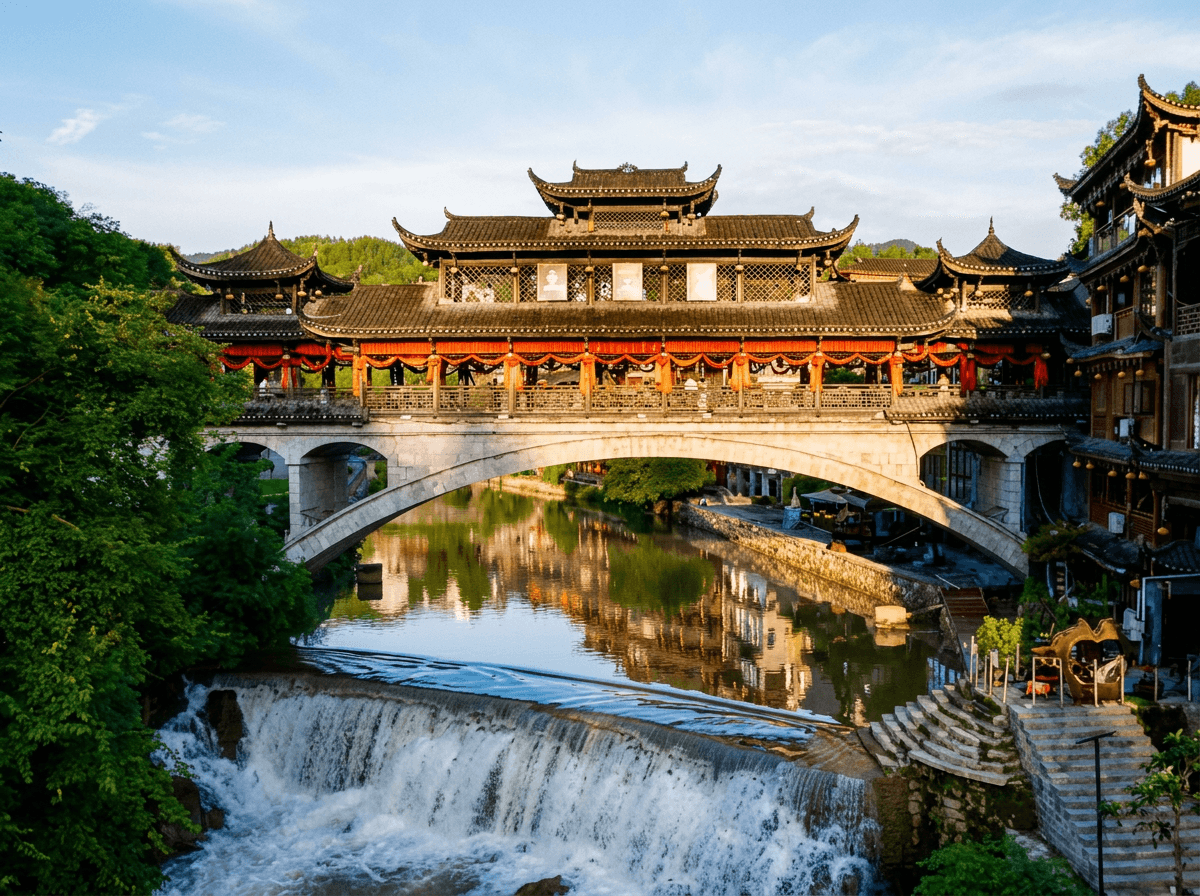
Most travelers heading through western Hunan stop at Zhangjiajie for the pillars and Fenghuang for the riverside lanterns, skipping right past the town sitting between them. Furong Ancient Town deserves a stop of its own, built directly above a sixty-meter waterfall that splits the settlement in two. This guide walks through what makes Furong Ancient Town worth the detour, from its waterfall and stilt houses to the film that changed its name and its fortunes.
The Waterfall That Gives the Town Its Name
Furong Ancient Town takes its defining feature from a waterfall that drops sixty meters over two stages, spreading roughly forty meters wide at its base. Locals call it "the ancient town hanging on the waterfall," a description that becomes obvious the moment the cascade comes into view behind rows of wooden buildings.
Water volume shifts noticeably by season. Rainfall between April and October fills the falls out considerably, giving the cascade its fullest, most dramatic appearance. Drier months thin the flow, though the surrounding rock formations and buildings still frame an impressive scene regardless of the season.
A residence known as Tusi's Residence sits directly beside the falls, built on stilts against the cliff face. This structure once housed local Tujia chieftains, and its position beside the roaring water makes it one of the more photographed spots in Furong Ancient Town.
Walking behind sections of the waterfall reveals a different perspective entirely. A path tucked along the cliff lets visitors pass close enough to feel the spray, watching the town's buildings from an angle few other ancient settlements in China can offer. Evening visits add another layer, as lights along the waterfall and surrounding buildings turn the whole scene into something closer to a stage set than an ordinary riverside town.
A History Stretching Back More Than Two Thousand Years
Furong Ancient Town traces its origins to the Tusi chieftain system, a form of hereditary local governance that once controlled much of this mountainous stretch of western Hunan. Records tie the settlement's founding to roughly 202 BC, placing its history well over two thousand years deep.
Originally called Wangcun, meaning royal village, the town served as an administrative center for the Tusi rulers who governed the region for centuries. Its position along the You River made it a natural trading hub, connecting inland Hunan with river routes carrying salt, tea, and other goods between provinces.
That trading history shaped the town's layout considerably. A stone-paved street, built from large slabs and climbing the hillside through a mix of large and small steps, once carried merchants and porters between the docks and the upper town. This street remains one of the best-preserved examples of its kind anywhere in Hunan.
Furong Ancient Town earned recognition as a national tourist attraction in 2012, formalizing a status the town had already gained through decades of gradual rediscovery. Despite that recognition, it still receives noticeably fewer visitors than nearby Fenghuang, giving Furong Ancient Town a quieter, less commercial atmosphere than its more famous neighbor.
Walking Through the Streets and Stilt Houses
Tujia architecture defines the visual character of Furong Ancient Town throughout its older sections. Wooden stilt houses, built to manage the site's steep terrain and proximity to water, line narrow alleys connecting the waterfront to higher ground above the falls.
The Tujia people, the region's dominant ethnic group, still make up a large share of the town's population today. Their presence goes beyond architecture alone, extending into local food, textiles, and craftwork sold along the main street running through Furong Ancient Town.
Cobblestone paths wind between shops selling local specialties, including a fermented tofu dish the town has become locally known for. Small guesthouses tucked into converted stilt houses let visitors extend their stay overnight, often with balconies positioned to look directly out toward the waterfall.
Quieter side streets away from the main tourist route reveal a more lived-in version of the town. Residents still use these lanes daily, hanging laundry between buildings and running small family shops that cater as much to neighbors as to visiting travelers passing through Furong Ancient Town.
The Film That Changed the Town's Name
Furong Ancient Town owes its current name to a film rather than its original founders. Before 1986, the settlement was known simply as Wangcun, a name tied directly to its Tusi-era administrative role.
That year, director Xie Jin released Hibiscus Town, a film set against the backdrop of China's Cultural Revolution and starring Liu Xiaoqing and Jiang Wen. Shot on location in Wangcun, the film became a nationwide success, and audiences began referring to the real town by its Chinese title, Furong, meaning hibiscus.
Local authorities eventually made the renaming official, and Furong Ancient Town has carried that name ever since. The film's success also introduced the town to a much wider domestic audience, setting off decades of gradually increasing tourism that continues today.
Visitors familiar with the film sometimes recognize specific buildings and street corners featured in key scenes. That overlap between a real place and a fictional story it inspired is rare enough that it shapes how many visitors experience the town, whether or not they have seen the movie itself.
Planning a Visit
Reaching Furong Ancient Town typically means a bus ride from either Zhangjiajie or Fenghuang, since the town sits roughly between both destinations in the region's mountainous terrain. Many travelers combine all three stops into a single multi-day itinerary through western Hunan.
Spring and autumn offer the most comfortable weather for exploring the town on foot, avoiding both summer humidity and the coldest winter temperatures at this elevation. Rainy season, running through summer, brings the waterfall to its fullest strength, which matters for visitors prioritizing the cascade over walking comfort.
An entry fee covers access to the scenic area, including the main waterfall viewpoints and the walkway behind the falls. Staying overnight, rather than treating Furong Ancient Town as a brief stop between bigger destinations, gives visitors a chance to see the waterfall lit up after dark, when crowds thin out considerably.
Conclusion
Furong Ancient Town sits between two more famous stops in western Hunan, and it holds its own against both. Its waterfall, stilt houses, and layered history stretching back to the Tusi era give it a character distinct from both Zhangjiajie's dramatic peaks and Fenghuang's riverside charm. Anyone building an itinerary through this part of China should treat Furong Ancient Town as more than a quick stopover, since a single overnight stay reveals far more of the town than a rushed afternoon visit ever coul