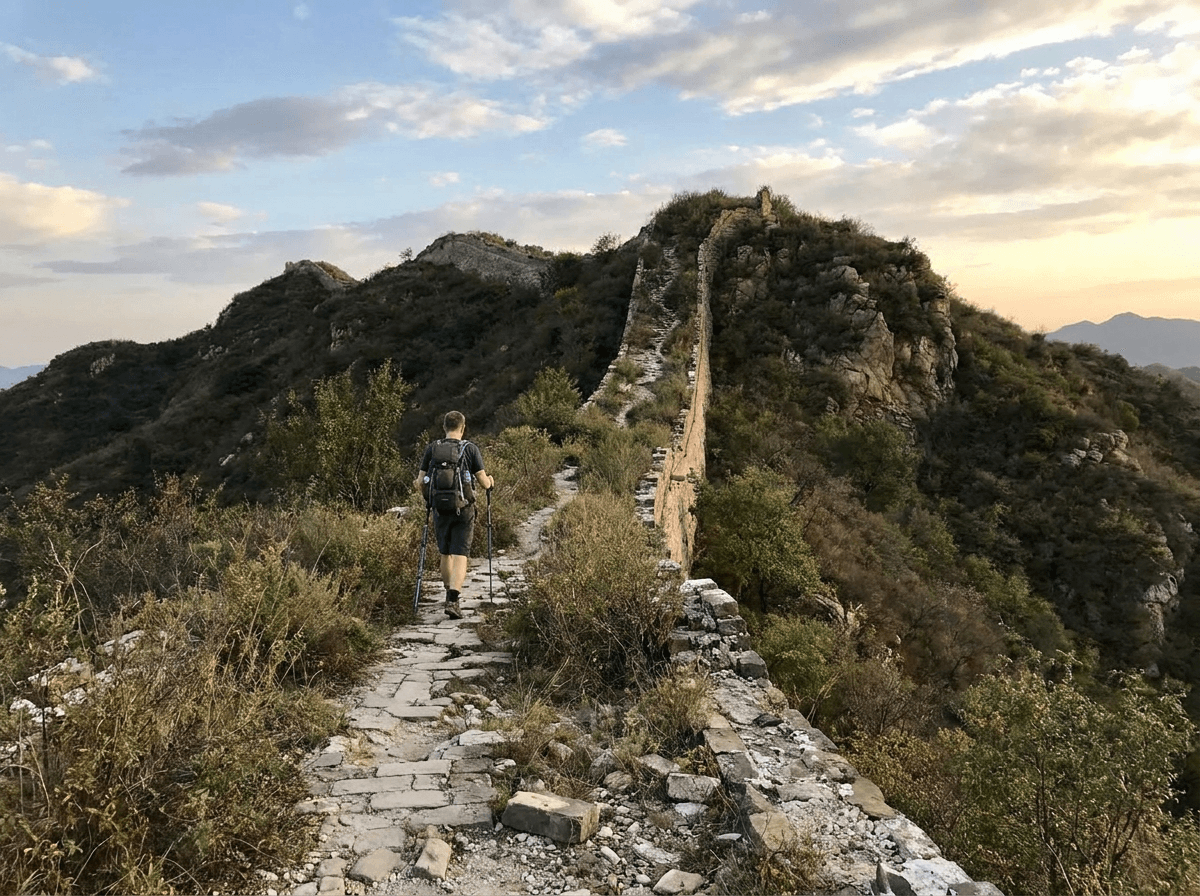
Most visitors picture the Great Wall as a polished, crowded tourist stop, complete with handrails, gift shops, and a cable car. The Jiankou Great Wall hike offers something entirely different. Built from rough dolomite stone in the Huairou District north of Beijing, this stretch has never been restored, and nature has reclaimed large sections of it over the centuries. For hikers seeking the wall in its rawest form, few experiences in China compare to the Jiankou Great Wall hike. This guide covers the route, its most demanding stretches, and what it actually takes to attempt this hike safely.
What Sets This Hike Apart From Other Wall Sections
Jiankou owes its dramatic character to its construction. Builders used dolomite rather than the brick found at nearby sections like Mutianyu, producing a harder, more uneven surface that has weathered differently over roughly six centuries. That material choice explains why the Jiankou Great Wall hike feels rougher underfoot than almost anywhere else along the wall.
The section stretches around twenty kilometers between two landmarks: the Nine-Eye Tower at its northwestern end and Ox Horn Edge Wall to the southeast. Twenty-eight watchtowers punctuate this distance, though many have partially collapsed, leaving crumbling brick and exposed stonework along the ridgeline.
No entrance gate or ticket booth manages access here. Organized commercial tours remain officially discouraged, though nothing formally bans individual hikers from climbing the wall on their own. Villagers near some trailheads occasionally collect a small informal fee, and inspectors sometimes discourage climbers at certain points, though enforcement varies considerably by season and location.
This lack of infrastructure is precisely the draw for many hikers. Unlike sections built around visitor convenience, the Jiankou Great Wall hike rewards those willing to navigate genuine wilderness conditions, steep unmarked paths, and a version of the wall that feels closer to its original, unmanaged state than any restored alternative nearby.
The Route and Its Toughest Stretches
Most hikers begin from Xizhazi Village to the south, climbing roughly ninety minutes before reaching the wall itself near a landmark called Jiankou Spot. From there, the route splits toward either the more technical western stretch or the comparatively gentler path east toward Mutianyu.
The middle section carries the hike's most serious reputation. Eagle Flies Facing Upward, a watchtower perched at the top of an extraordinarily steep climb, earned its name from the idea that even a bird would need to fly straight up just to clear it. The approach, known as Sky Stair, rises at roughly seventy to eighty degrees, with some steps barely wide enough for a single foot.
Zhengbei Tower offers a brief respite along the way. Recognized as the largest and best-preserved watchtower on this stretch, it provides a natural stopping point for photographs, particularly around sunrise or sunset when light spreads across the surrounding ridgelines. Many hikers pause here longer than planned simply to take in the view before continuing.
Beijing Knot marks another key junction, where three separate sections of wall converge amid steep terrain. Hikers continuing north from here eventually reach the Nine-Eye Tower, named for its nine window openings on each face and positioned high enough to offer views stretching toward Beijing on a clear day. Loose stone, exposed drops, and unpredictable footing define much of the Jiankou Great Wall hike throughout these central stretches, so hikers without a head for heights or solid balance should think carefully before pushing through discomfort on the more technical sections.
Safety Realities Worth Taking Seriously
Injuries happen here more often than at restored sections, and the terrain explains why. Crumbling stone, unmarked branch paths, and sheer drops on either side of the ridge combine to make simple missteps genuinely dangerous rather than merely inconvenient. Anyone attempting the Jiankou Great Wall hike should treat it as a genuine outdoor undertaking rather than a casual walk.
Weather changes the calculation significantly. Rain turns the dolomite surface slick almost immediately, and fog can obscure both the trail and the drop-offs beside it. Attempting this hike during or shortly after rain carries meaningfully higher risk than a dry-weather attempt, and experienced hikers routinely postpone plans rather than push through poor conditions.
Cell signal disappears in parts of this stretch, complicating any attempt to call for help during an emergency. Hikers should tell someone their planned route and expected return time before setting out, given the genuine possibility of losing contact along certain sections. Carrying a fully charged phone and a small backup battery adds a reasonable layer of protection.
Proper footwear matters more here than almost anywhere else covered in general hiking advice. Grippy soles and ankle support handle the uneven dolomite far better than casual shoes, particularly through Sky Stair and the sections immediately surrounding it. Hiring an experienced local guide removes much of this risk for first-time visitors, since guides familiar with current trail conditions can flag unstable sections and provide genuine reassurance during the hike's more exposed stretches.
Timing and Getting There
Spring and autumn offer the most favorable conditions for the Jiankou Great Wall hike. April and May bring wildflowers and comfortable temperatures, while September and October add crisp air alongside golden and red foliage across the surrounding mountains. Both seasons keep humidity manageable, which matters considerably during the steepest climbing sections.
Summer humidity and sudden storms make this hike considerably less predictable during that season, with afternoon downpours arriving quickly and often without much warning. Winter ice, meanwhile, turns already unstable footing into a genuinely hazardous proposition, particularly along the steepest sections near Sky Stair, so most experienced hikers avoid attempting the route between December and February.
Reaching the trailhead typically requires a private car or hired driver from Beijing, since public transport does not run directly to the villages at the base of the climb. The drive from downtown Beijing to Xizhazi Village generally takes around two hours depending on traffic, and arranging a driver to wait at the Mutianyu exit point simplifies logistics considerably for hikers planning a one-way route rather than a there-and-back hike.
Extending the Route Toward Mutianyu
Many hikers turn the Jiankou Great Wall hike into a longer traverse by continuing east toward Mutianyu rather than retracing their steps back to Xizhazi Village. This route passes Ox Horn Edge Wall before reaching the restored, ticketed section, where a cable car or toboggan offers a welcome descent after hours of climbing over uneven, unmaintained terrain.
Combining both sections in a single day creates a striking contrast that many hikers describe as the highlight of the entire trip. Moving from crumbling, unmanaged stonework into a polished, visitor-friendly attraction within the space of a few hours means experiencing two entirely different versions of the same structure, separated by only a few kilometers of ridgeline.
Planning this extended route requires slightly more preparation than a simple there-and-back hike. Since the exit point differs from the starting point, arranging transportation in advance, either through a guide or a driver willing to wait at Mutianyu, prevents unnecessary stress once the physically demanding portion of the day is finally behind you.
Conclusion
The Jiankou Great Wall hike offers something increasingly rare: a chance to experience an ancient structure exactly as time and weather have left it, without handrails, crowds, or restoration smoothing over its rough edges. Reaching that experience safely requires real preparation, proper footwear, and honest self-assessment about physical ability and comfort with exposed heights. Hikers who respect those demands, plan around weather and timing, and consider hiring local guidance come away with a version of the Great Wall that few visitors ever witness firsthand.